
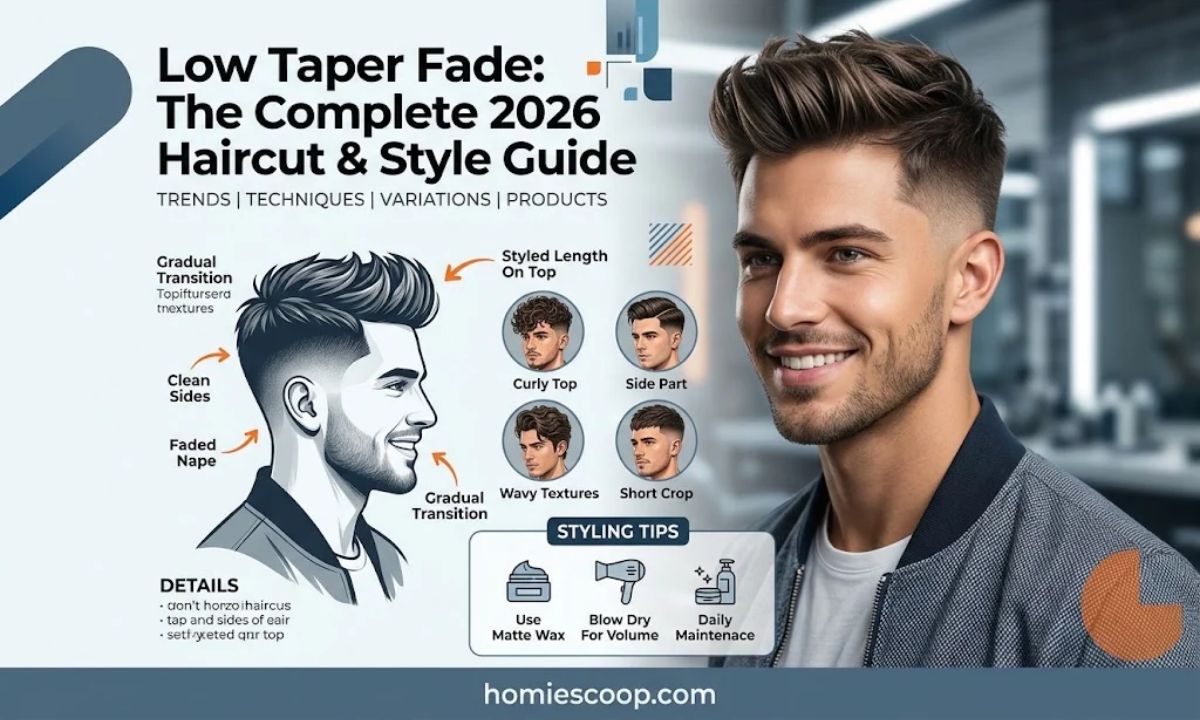
Clean around the edges, flexible through the top, and easy to adapt to different hair textures, the Low Taper Fade remains one of the most versatile men’s haircut choices for 2026. Its appeal comes from a controlled transition around the lower sides, sideburns, ears, and neckline while preserving plenty of freedom on top.
This guide explains the Low Taper Fade definition, how the haircut differs from a Low fade, which versions work with straight hair, wavy hair, curly hair, coily hair, thick hair, and dense curls, and how to communicate the desired result to a barber. The structure follows the competitor article’s topical organization, while the explanations and examples here are original.
The quick version
- A Low Taper Fade keeps the fade height low around the sideburns, ears, and neckline.
- The blend is usually softer and more gradual than a more aggressive skin fade.
- The top can remain short, medium, or considerably longer depending on the desired hairstyle.
- Straight hair, wavy hair, curly hair, and coily hair can all work with the cut.
- A number 2 guard or Number 3 guard can be used as part of the transition, depending on the barber’s technique.
- A natural hairline, natural edge, or crisp line-up can change the overall finish considerably.
- Regular trims help maintain the haircut, although a softer blend can make regrowth less noticeable.
- Face shape, hair density, natural texture, and personal style should influence the final design.
What is a low taper fade haircut?

A Low Taper Fade haircut gradually reduces Hair length around the lower perimeter of the head rather than taking the Fade high into the sides. The Taper usually focuses on the Sideburns, Ears, Neckline, and lower Back, creating a controlled Transition between the longer Hair and shorter areas.
The important detail is Fade height. A low placement means the Fade remains close to the Natural hairline instead of climbing toward the upper Sides. This creates a Natural blend and Gentle blend that can look polished without producing excessive Contrast.
A Barber may use several Guard lengths while Blending. A Number 2 guard or Number 3 guard can establish a fuller starting point, while shorter settings refine the lower Transition. The exact Haircut length depends on Hair texture, Hair density, and the client’s preferred level of Skin exposure.
Unlike a Skin fade, the shortest portion does not necessarily need to expose Bare scalp. Some versions can approach the Scalp closely, but a guarded finish generally leaves more visible Hair and produces a softer appearance.
The finished Hairstyle can therefore range from a Classic top to a Textured top, Messy top, Longer top, Fringe, Comb-over, Slick back, or Middle part. The Low Taper Fade provides the perimeter structure while the top determines much of the hairstyle’s personality.
Low taper fade vs low fade: what’s the difference?

The Low taper fade vs low fade distinction is mainly about placement, technique, and finish. A Low fade describes a Fade that begins relatively low on the head, whereas a Taper generally concentrates the shortening around specific perimeter areas such as the Sideburns and Neckline.
In practical barber language, the terms can overlap. A client asking for a Low taper should explain whether they want a very soft Blend, visible Contrast, a Natural finish, or a Sharp finish. The more precise the request, the easier it is for the Barber to reproduce the intended look.
A Low taper fade vs low fade comparison also depends on Skin exposure. A Low fade may extend farther across the Sides, while a Taper can preserve more of the original Hair shape. Neither description automatically determines whether Bare scalp will appear.
The Taper vs fade distinction becomes clearer when looking at the Transition. A Taper typically keeps the change localized around the perimeter, while a conventional Fade may spread the reduction farther across the Sides and Back.
A Low mid taper fade sits between a very low perimeter Taper and a more noticeable Mid fade. Its Blend placement can create additional Contrast while retaining some of the Gentle transition associated with a Taper.
Why low taper fade haircuts are so popular

The popularity of this haircut comes partly from its flexibility. A Low Taper Fade can be paired with a short crop, Longer hairstyle, 360 waves, Afro, Twists, Locs, Curls, or a classic combed top without forcing the entire haircut into one silhouette.
Modern grooming also favors styles that can move between different environments. A subtle Low Taper Fade can work with casual clothing, many Dress codes, Workplace grooming expectations, and an Office hairstyle without requiring a dramatically exposed Scalp.
Social media has also made variations such as the Low taper fade fringe, Edgar, Takuache, and textured versions more visible. These are examples of how the same basic Transition can be modified through Top length, Texture, Fringe placement, and Hairline detailing.
Another advantage is regrowth. Because the Fade height stays low and the Contrast can remain relatively subtle, the haircut can retain a presentable appearance as the Hair grows. That does not eliminate Maintenance, but it can make the period between Barber visits more forgiving.
For people interested in 2026 haircuts, the style also fits the broader movement toward wearable haircut designs. It can be Clean, Sharp, Relaxed, Natural, Modern, or Classic depending on the Blend, Top, Edges, and styling method.
Best low taper fade haircuts for men
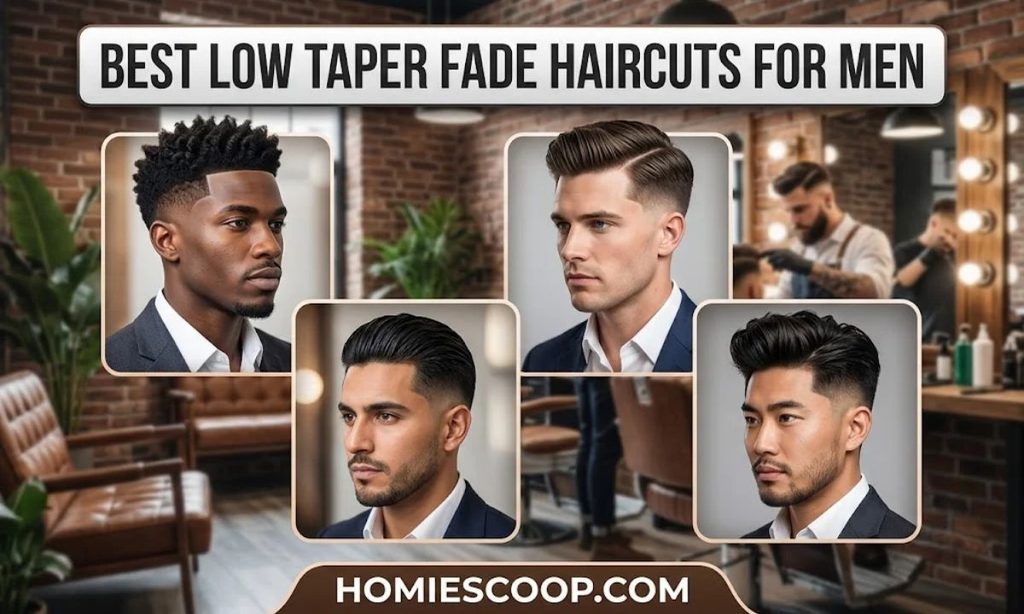
The basic haircut is adaptable enough to support numerous top styles. Consider these options before your next Barber visit:
- Classic low taper fade
A Classic top keeps the Hair controlled without demanding a complicated styling routine. It works particularly well for people who want a Clean look and straightforward Maintenance. - 360 waves low taper fade
A 360 waves low taper fade preserves the Wave pattern across the Top while keeping the perimeter controlled. The Barber can shape the Sideburns and Neckline without removing too much surrounding Hair. - Textured crop low taper fade
A Textured crop low taper fade uses a Short top with separated pieces and a subtle perimeter Blend. Point cutting can create Movement without sacrificing Overall shape. - Fringe low taper fade
A Fringe low taper fade pushes Hair forward toward the Forehead. The Fringe can be blunt, Choppy, soft, or highly Textured. - Longer-top low taper fade
A Longer-top low taper fade keeps additional Length above the Sides. This gives the wearer more options, including a Comb-over, Slick back, Middle part, or Tousled finish. - Messy low taper fade
A Messy low taper fade combines controlled perimeter work with a Loose, Tousled, and deliberately Unbothered Top. The Clean sides prevent the Messy finish from looking accidental. - Curly low taper fade
A Curly low taper fade leaves Natural curls on top while reducing Bulk around the Ears and lower Sides. - Low taper fade fringe
A Low taper fade fringe emphasizes forward Movement. It can be paired with a Textured fringe with low taper fade when additional separation is desired. - Middle part low taper fade
A Middle part low taper fade works when enough Top Length remains to form a Center part or curtain-like shape. - Low taper fade middle part
A Low taper fade middle part creates a softer contrast between the longer central Top and the shorter perimeter. - Low taper fade afro
A Low taper fade afro retains Afro volume while cleaning the perimeter around the Ears and Neckline. - Low taper fade for Black men
A Low taper fade for Black men can be adapted for Natural texture, Curls, Coily hair, 360 waves, Twists, and Locs. - Hispanic Mexican low taper fade
A Hispanic Mexican low taper fade can incorporate the Edgar or Takuache aesthetic while adjusting the Hairline, Fringe, and overall Contrast to the individual’s preferences. - Low taper fade with a beard
A Beard can connect naturally into the Sideburns, creating continuity between the haircut and facial grooming. - Low taper fade with longer curls
Longer Natural curls can remain untouched while the lower perimeter receives a controlled Taper. - Low taper fade with textured top
A Textured top introduces Movement and Shape without requiring a rigid finish. - Low taper fade with slick back
Additional Length allows Hair to be directed backward for a Sleek appearance. - Low taper fade with comb-over
A Comb-over can be Natural or deliberately structured with a Hard part. - Low taper fade with short top
A Short top reduces styling time and can create a particularly Low-maintenance haircut. - Low taper fade with twists or locs
Twists and Locs can retain substantial Length while the perimeter receives controlled Cutting.
The key principle is simple: the Taper controls the lower perimeter, while the Top establishes the hairstyle. A Classic top can therefore produce a very different result from a Messy top even when the same Fade height is used.
Low taper fade for curly hair
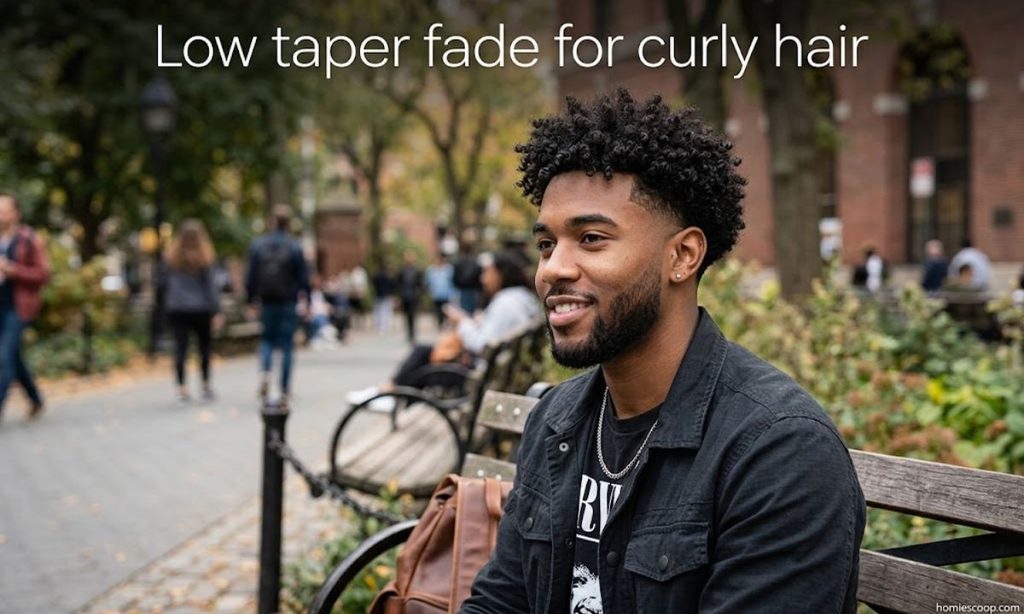
A Low Taper Fade for curly Hair works because the lower perimeter can be cleaned without taking away the Natural curls that provide Volume and Movement. Keeping the Fade low can also prevent the Sides from becoming overly narrow.
Curly hair should be assessed according to its Hair pattern rather than its appearance while wet. Damp Hair can look significantly longer than dry Curls, so a Barber may need to account for shrinkage before deciding the final Haircut length.
A Curl cream can improve Curl definition, while Light mousse can provide Bounce with a softer hold. Applying product to Damp hair and using a Diffuser can help preserve Natural shape while limiting Frizz.
Dense curls may require careful Bulk control. Removing too much Hair can make the Top appear uneven once the Curls contract, while leaving too much Bulk near the Ears can make the perimeter look heavy.
A Curly low taper fade can also be combined with a Fringe, Middle part, Longer top, or Messy finish. Natural curls provide much of the Texture automatically, so the Styling routine can remain relatively simple.
For Coily hair, the same principle applies but the Barber may use different Cutting techniques. A Low taper fade for Black men can frame 360 waves, an Afro, Twists, or Locs while preserving the desired Natural texture.
Low taper fade for straight and wavy hair
Straight hair gives the Barber a clear view of every Transition, so Blend quality becomes particularly visible. A Natural blend can create a softer result, while a Sharp finish makes the Edges and Hairline more prominent.
Wavy hair naturally introduces Movement and Texture. A Low Taper Fade can remove excess Bulk near the Sides while leaving enough Length on top for Waves to form their natural pattern.
Straight hair can sometimes fall flat when the Top is cut too Short. A Longer top, light Texture, or controlled layering can create additional Volume without making the Hair appear overly styled.
For wavy Hair, lightweight products are often useful because heavy products can suppress the Natural shape. A small amount of Light mousse can encourage Movement while maintaining a Relaxed appearance.
A Low taper fade straight hair combination can therefore range from a Classic top to a Textured crop. A Low taper fade for wavy hair can use the same perimeter concept while leaving additional Length for Natural waves.
How to style a textured or messy top
Texture begins with the Haircut. A Barber can use point cutting, selective texturizing, or other Cutting methods to prevent the Top from appearing like one solid block.
A Textured top can be styled with a small amount of product distributed through Damp hair or dry Hair. Using fingers instead of a comb can preserve separation and create more Movement.
For a Messy top, the objective is not simply to make the Hair look untidy. The best result is controlled disorder: the Hair has Direction, Volume, and Texture while the lower perimeter remains Clean.
Thick hair often benefits from reducing Bulk strategically rather than removing large amounts of Length. This preserves the Fuller appearance while making Daily styling easier.
A Tousled top works particularly well with a Low Taper Fade because the clean lower area provides Contrast against the Loose styling above. The overall effect can remain Modern without becoming overly Precise.
How to ask your barber for a low taper fade

Communication is one of the most important parts of a successful Barber visit. Instead of relying only on the phrase Low Taper Fade, describe the Fade height, desired Length, and finish.
A useful request is: “Keep the taper low around my Sideburns and Neckline, preserve my Natural hairline, and blend the Sides gradually without taking the Fade too high.”
Then specify the Top. You might request a Short top, Longer top, Textured crop, Fringe, Comb-over, Slick back, Middle part, Afro, or Natural curls.
Tell the Barber how much Skin exposure you want. If you do not want Bare scalp, say so directly. If you prefer a Skin fade appearance, mention that as well.
Guard length is another useful detail. A Number 2 guard and Number 3 guard do not create identical results, and the Barber may use several Guard lengths during Blending.
A reference photo can help, especially when terms such as Low fade, Taper, Fade, Blend, and Natural finish are interpreted differently by different clients and barbers.
For a Crisp line-up, Hard line, or Hard part, say so before Cutting begins. Likewise, if you prefer a Natural edge, Natural hairline, or less structured finish, make that clear.
How to style and maintain a low taper fade

Maintenance depends on Hair growth, Fade height, Styling preferences, and how precise you want the Edges to remain. A softer Low Taper Fade can remain Wearable even when a few weeks of Regrowth have appeared.
A typical Barber visit can include a Trim, Line-up, Sideburn cleanup, Neckline cleanup, and Hairline cleanup. The Blend itself should generally be handled carefully rather than repeatedly altered at home.
Hair care also matters. Washing too aggressively can dry the Scalp, while excessive product can reduce Volume and make the Top appear heavy.
For curly or coily Hair, Curl cream can support Curl definition. For wavy or straight Hair, Light mousse can create flexible Movement. Damp hair is generally an effective starting point for products that need even distribution.
A Diffuser can help with curls, while finger styling can create Texture definition for shorter or longer Hair. The goal is to support the Natural shape rather than fight the Hair pattern.
A Wash-and-go routine can work particularly well for curls and coils. People with straighter Hair may prefer a short blow-dry routine, while a Slick back or Comb-over may need additional Shape retention.
Does a low taper fade suit your face shape?
Face shape should guide the Top more than it dictates whether you can wear the haircut. The same perimeter Fade can produce different facial effects depending on Top Length, Volume, Fringe placement, and overall shape.
- Round face shapes: Additional Top Volume or a Textured top can visually lengthen the silhouette.
- Oval face shape: Many Top styles work because the proportions are comparatively balanced.
- Square face shape: A controlled Top can complement the stronger jaw and Side profile.
- Long face shapes: A Fringe or moderate Top Volume can prevent excessive vertical emphasis.
- Heart-shaped face: Texture and balanced Side Volume can help distribute attention.
Forehead size can also influence whether a Fringe, Center part, or Longer hairstyle is preferable. Ears and Temple shape may influence how far the Taper should extend.
Hair density matters as well. Dense hair can support substantial Texture and Volume, while lower density may benefit from shorter, controlled styling that avoids making the Top appear overly thin.
Facial appearance is therefore influenced by several variables rather than Fade height alone. A skilled Barber can adjust the Blend placement, Hairline placement, and Top Length to create a balanced result.
Low taper fade Black male
A Low taper fade Black male style can be adapted to many forms of Natural texture, including 360 waves, Coily hair, an Afro, Twists, and Locs. The perimeter can remain subtle while the Top preserves its characteristic pattern.
For 360 waves, the Wave pattern should remain visually continuous around the Top. The Barber can focus on Sideburns, Ears, and Neckline without cutting too far into the trained pattern.
With an Afro, the objective can be to maintain fullness while reducing perimeter Bulk. A controlled Transition creates definition without requiring the entire silhouette to become narrow.
Twists and Locs offer another option. The Top can retain Length while the lower perimeter receives a Taper. This creates Contrast without sacrificing the main hairstyle.
Hair density and natural curl pattern should determine Guard length rather than assuming one setting works for everyone. A consultation before Cutting helps preserve the intended shape.
Mid taper fade
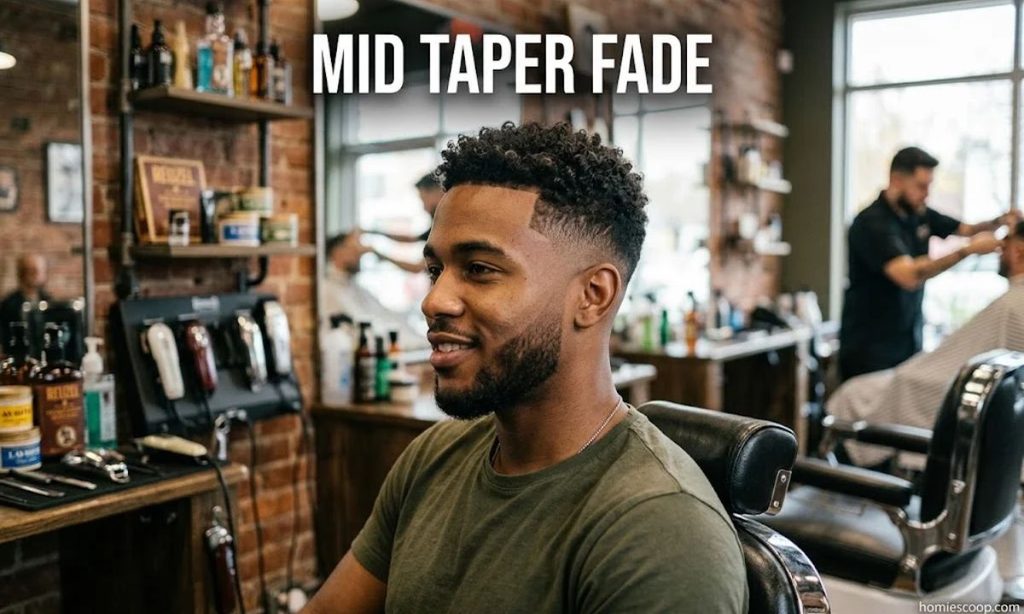
A Mid taper fade places the Blend higher than a conventional low perimeter Taper, creating more visible Contrast around the Temple area. The additional height can produce a stronger Side profile while leaving substantial Top Length.
A Low mid taper fade can be useful for someone who wants more Definition than a very subtle Taper but does not want the full exposure associated with a higher Fade. The exact Fade height should be shown with a reference photo.
The distinction between Low taper vs low fade and Mid fade comes down to placement and the amount of Hair being reduced. A Mid fade generally produces a more obvious change across the Sides.
A Mid taper fade can work with straight Hair, Wavy hair, Curly hair, and Coily hair. The appropriate Blend intensity depends on Hair density and the desired Contrast.
Read More: Low taper fade mullet: styles, hair types, face shapes, and upkeep
Low taper fade curly hair
A Low taper fade curly hair style should account for shrinkage, Curl pattern, Density, and Natural shape. The lower perimeter can be cleaned while the Curls remain fuller above.
Dense curls may require selective removal of Bulk near the Ears rather than aggressive reduction throughout the Sides. This keeps the Top balanced after the Hair dries.
A Curl cream can enhance Curl definition, while Light mousse can provide Bounce. Damp hair allows products to spread more evenly, and a Diffuser can help maintain Shape retention.
The most important styling objective is to avoid disrupting the Natural texture. Curls already provide substantial Texture and Movement, so the perimeter does not need excessive Contrast to look finished.
Low taper fade V
A Low taper fade V refers to a perimeter shape in which the Back neckline is cut toward a central point or V-shaped finish. The shape can create a more deliberate Back profile.
The V should be discussed before Cutting because neckline design significantly affects the Overall shape. Some people prefer a Natural neckline, while others want a more defined geometric finish.
The Barber can combine the V with a Soft blend, Gentle blend, or sharper Transition depending on the desired appearance. A Clean edge can make the V more obvious.
People with a Longer top may prefer a subtle V because it adds structure without dominating the rest of the Haircut. A Short top can make the neckline design more noticeable.
Low taper fade straight hair
A Low taper fade straight hair style benefits from careful Blending because straight strands reveal every Transition. Uneven Guard work can become more visible when there is little Natural curl or wave to disguise it.
A Short top creates a neat and controlled finish, while a Longer top provides room for a Comb-over, Slick back, Middle part, or Textured hairstyle.
Straight Hair can also work with a Fringe. A Low taper fade fringe can soften the Forehead and create a more youthful silhouette without changing the low perimeter.
For styling, a lightweight product can provide Texture without making the Hair greasy. A matte finish can also preserve a Modern look without excessive shine.
Black Low taper fade
The Black Low taper fade category includes numerous variations built around Natural hair patterns. The haircut can frame 360 waves, Afro volume, Twists, Locs, or tightly Coiled curls.
The perimeter should be selected according to the wearer’s desired Contrast. A subtle Natural blend creates a quieter result, while a Crisp line-up introduces more definition.
A Barber should consider Hair density, Hairline shape, Temple placement, and the relationship between the Top and Sides. The same Guard length can look different on different hair types.
For people who prefer minimal styling, a Natural texture finish can make the haircut easy to maintain. For more deliberate styling, Curl definition, Wave pattern, or structured Top Length can become the focal point.
The bottom line
The Low Taper Fade remains a flexible choice because the perimeter can stay controlled while the Top changes dramatically. Straight hair, Wavy hair, Curly hair, Coily hair, thick hair, and dense hair can all be approached differently without abandoning the basic haircut.
The best result depends on communication: identify the Fade height, explain the desired Blend, specify the Top Length, and show the Barber whether you want a Natural finish or Sharp finish. From a Textured crop to 360 waves, Afro volume, a Fringe, or a Longer hairstyle, the haircut can be adapted to personal style and grooming needs.
In short
A well-designed Low Taper Fade creates a gradual perimeter Transition while leaving room for the Top to express Texture, Volume, Movement, and personal style. Its relatively low Blend placement makes it suitable for people who want a Clean haircut without excessive Skin exposure.
Choose the Top according to Hair type, Face shape, Hair density, and Daily styling habits. Then maintain the Sideburns, Neckline, Edges, and Hairline through regular trims while allowing the main Blend to grow naturally.
Go deeper: low taper fade guides
The haircut can be explored through several practical categories:
- Taper fade: Understand the difference between a Taper and a broader Fade.
- Low versus mid: Compare Fade height, Contrast, and Blend placement.
- Hair texture: Adapt the haircut to Straight hair, Wavy hair, Curly hair, or Coily hair.
- Waves: Consider 360 waves and the correct perimeter treatment.
- Afro styles: Preserve Natural volume while controlling the perimeter.
- Twists and Locs: Keep the main Length while refining the lower Sides.
- Fringe: Combine a forward Top with a low perimeter.
- Middle part: Preserve enough Length for a Center part.
- Slick back: Leave enough Top Length for backward styling.
- Comb-over: Use Natural or deliberate parting depending on preference.
- Textured crop: Keep the Top short and Choppy for easier styling.
- Longer hair: Preserve Movement and flexibility through the Top.
- Beard combinations: Continue the Sideburn Transition into facial Hair.
- Neckline designs: Choose between Natural and defined finishes.
- Maintenance: Schedule trims according to Regrowth and desired Sharpness.
Frequently Asked Questions
Is fade halal in Islam?
There are differing Islamic scholarly views about fades, particularly when a haircut involves shaving some areas very closely while leaving others substantially longer. The ruling can depend on the specific haircut and the interpretation followed by the individual or their scholar.
Is low taper fade a thing?
Yes. The term is widely used to describe a Taper or Fade concentrated around the lower perimeter of the Haircut, particularly near the Sideburns, Ears, and Neckline.
What is a taper fade with low fade?
This wording generally describes a Fade that starts low while using a Taper-style Transition around the perimeter. The intended result is usually a lower Blend with less visual exposure than a higher Fade.
What is the most attractive fade?
There is no universal answer because attractiveness depends on personal preference, Face shape, Hair type, Hair density, styling habits, and individual Facial appearance.
What is the gen z haircut?
The phrase “Gen Z haircut” can refer to several contemporary styles rather than one standardized haircut. Examples include textured crops, Fringe styles, Middle parts, loose longer Tops, Edgar variations, and Taper-based cuts.
Conclusion
The Low Taper Fade offers a practical balance between a Clean perimeter and a flexible Top. Its low Fade height can preserve more of the original Hair silhouette while allowing the wearer to choose a Classic, Textured, Curly, Wavy, Messy, Fringe, or Longer hairstyle.
For the best result, communicate the desired Blend, Guard length, Hairline, Neckline, and Top length before the Barber begins Cutting. With the right combination of Hair care, Styling, and Maintenance, the haircut can remain Wearable across different settings and personal styles.
