

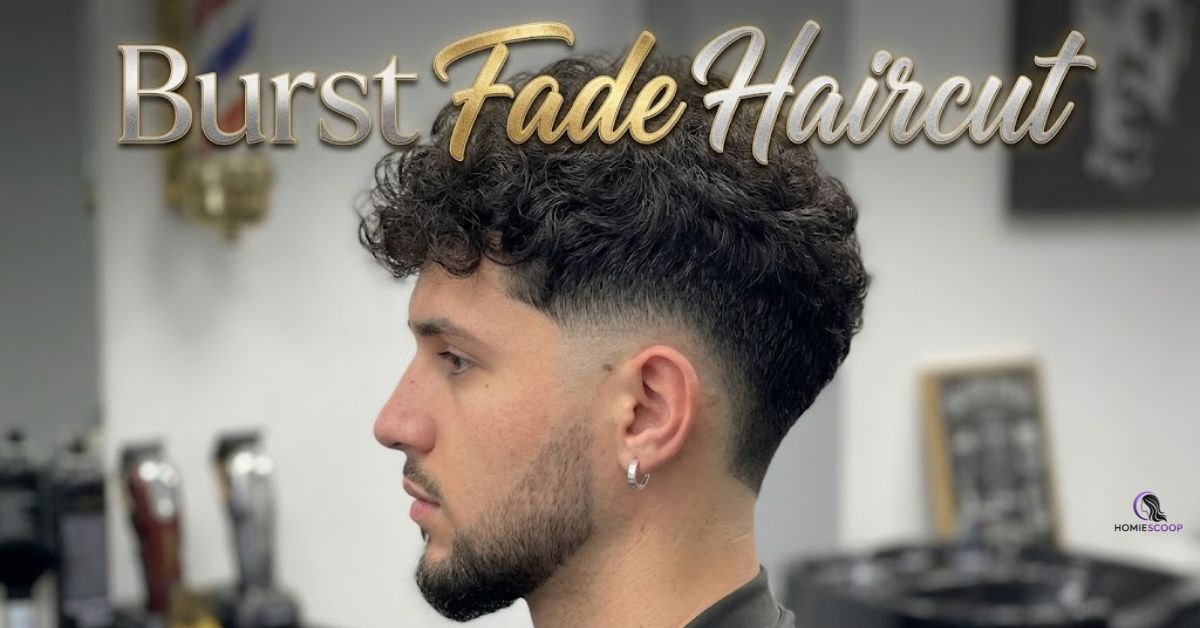
A burst fade haircut curves around the ear rather than following a straight side line, creating a rounded, semi-circular fade shape while preserving more length toward the back and crown. That distinctive fade transition gives this men’s hairstyle more movement than a conventional fade haircut.
The Burst Fade Haircut Guide below covers 40 haircut styles, including a burst fade mullet, mohawk, quiff, textured crop, curly top, longer top, and several options for straight, wavy, curly, coily, thick, fine, and thinning hair. The key is matching the fade technique to your face shape, hair texture, hair density, and maintenance routine.
What is a Burst Fade Haircut?
A burst fade haircut is a modern fade that concentrates the shortest hair around the ear while maintaining length toward the back of the head. The fade shape resembles a curved fade, rounded fade, or semi-circular fade because the fade line follows the natural curve of the head instead of traveling straight downward.
The result is a haircut with a controlled hair gradient and a noticeable fade transition. A skilled barber uses guideline work and clipper work to create a smooth blend without destroying the natural hair flow. Unlike some versions of a traditional fade haircut, the burst fade preserves useful back length and crown length.
This structure explains why the style works with a mullet, mohawk, quiff, textured crop, curly top, or longer top. It can also be adapted as a skin fade, taper fade, drop fade, low fade, mid fade, or high fade depending on how much contrast you want.
The shape should also follow the natural curve of the head. The area around the ear and behind the ear requires particular attention because the hair growth direction often changes there. Good barber training helps a barber recognize that change and adjust the fade technique accordingly.
Who Should Get a Burst Fade Haircut?
A burst fade is particularly useful for someone who wants a clean, modern men’s hairstyle without removing all the hair from the sides and back.
- Curly hair benefits from the curved fade because natural curls remain prominent on top.
- Wavy hair gains definition while the sides stay controlled.
- Coily hair can retain natural volume and shape.
- Straight hair displays the fade line very clearly.
- Thick hair can lose unwanted bulk around the ear.
- Fine hair can benefit from a shorter, balanced silhouette.
- Thinning hair can look more intentional when the fade height is selected carefully.
- Round face shapes can use height and a controlled side shape for additional facial definition.
- Oval face shapes have considerable flexibility.
- Square face shapes pair naturally with structured haircut styles.
- Longer hair can remain at the top or back without making the sides look untidy.
- Short hair can produce a low-maintenance haircut with little daily styling.
A low fade usually produces a subtle result, while a mid fade provides more contrast. A high fade creates the strongest visual separation. Your barber should consider the hairline, jaw, cheek area, head shape, and hair growth pattern before deciding where the fade guideline belongs.
The most flattering result is rarely determined by trend alone. Face shape, natural texture, hair density, hair volume, and personal styling preferences all influence whether the final silhouette looks sharp, clean, modern, polished, or intentionally relaxed.
Why Burst Fade Haircuts Are Trending in 2026
The popularity of the burst fade continues because it offers several haircut variations without changing the fundamental technique. A single curved fade can support a subtle professional appearance or a bold fashion-forward haircut.
The style also photographs well because the rounded fade creates visual dimension from the front, side, and rear. Social media and short-form video have helped make these haircut styles highly visible, particularly when a barber demonstrates the fade execution from multiple angles.
The current 2026 hairstyle trends favor natural texture, longer top sections, textured hairstyles, and combinations that mix traditional barbering with modern styling. A burst fade works particularly well within that direction because it can preserve hair movement while maintaining a clean finish.
A low burst fade looks subtle and natural. A high burst fade delivers high contrast. A burst fade with design can become more expressive, while a burst fade mullet or burst fade mohawk creates a stronger silhouette.
Modern barbering has also made the technique easier to customize. Better clipper work, improved fade technique, and detailed guideline work allow a barber to adapt the same basic fade shape to different hair textures and face shapes.
Where the Burst Fade Comes From
Modern fade haircut history is connected to military haircuts, military tradition, and 20th-century barbering, where controlled short sides became practical and recognizable. Traditional fades gradually shortened the hair instead of cutting the entire side to one length.
The burst fade developed as barbers experimented with a curved fade around the ear. Rather than forcing a straight fade line, the barber could preserve more hair at the back and crown while creating a rounded transition around the ear.
That development fits the broader haircut evolution from traditional fades to modern fade techniques. Barbers increasingly used the natural curve of the head as a guide, producing haircut styles that looked less rigid and more compatible with natural texture.
Social media influence accelerated the change. Barbering trends became visible worldwide through short-form video, making specialized fade execution easier for clients to discover and request. Modern barber culture now combines barbershop tradition with haircut innovation and fashion-forward experimentation.
35 Burst Fade Haircut Styles for Men
Below are the original 35 styles covered by the competitor structure, followed by five additional useful variations. Together, these provide 40 practical options for different face shapes, textures, lengths, and styling preferences.
1: Burst Fade Mullet
The burst fade mullet keeps the sides controlled while allowing the back to remain noticeably longer. The rounded fade protects the mullet back from looking disconnected, creating a deliberate relationship between the short sides and longer back.
For the best result, discuss the back length, crown length, and desired hair flow before the clippers begin. Longer back length creates stronger hair movement, while a shorter mullet back gives a cleaner, more restrained silhouette.
Styling works well with light mousse, hair cream, or texture spray. The goal is soft control rather than excessive product, especially when natural texture already provides volume.
Low Burst Fade Mullet
A low burst fade mullet keeps the fade close to the ear and neckline. It is a good choice when you want the mullet shape without an extremely dramatic contrast.
The lower fade line also makes fade upkeep easier because the grow-out is less obvious. A 3–4 week maintenance window can work for many people, although hair growth varies.
Mid Burst Fade Mullet
The mid burst fade mullet places the fade higher around the side of the head while retaining the longer back. This produces a balanced contrast that can work especially well with straight hair and wavy hair.
It is a useful middle ground between a low burst fade and a high burst fade. The fade transition remains visible without dominating the entire haircut.
High Burst Fade Mullet
A high burst fade mullet creates maximum contrast around the ear and side of the head. The longer back becomes the focal point, producing a bold and fashion-forward silhouette.
This version demands stronger fade upkeep because the contrast becomes obvious as hair grows. Regular trims help maintain the shape retention and clean finish.
Straight Hair Burst Fade Mullet
Straight hair makes every detail of the fade line visible. That means the barber needs strong guideline work and precise blending to avoid uneven transitions.
A matte styling cream or texture spray can create movement in otherwise flat straight hair. Layered hair through the back can also improve hair flow and prevent the mullet from appearing too heavy.
Curly Hair Burst Fade Mullet
A curly hair burst fade gives the mullet more natural volume and movement. Natural curls create texture around the top and back while the curved fade keeps the area around the ear controlled.
Use curl cream on damp hair, then scrunch rather than brushing aggressively. This supports curl definition, natural shine, frizz control, and a natural finish.
2: Low Burst Fade
The low burst fade is the most subtle of the main fade heights. It begins close to the ear and keeps more hair on the side of the head.
This makes it suitable for someone trying a burst fade for the first time or someone who wants a professional, low-maintenance haircut. The soft transition also works well with a clean neckline.
A low fade can pair with a textured top, curly top, longer top, short hair, or medium hair. It is especially useful when you want shape without excessive contrast.
3: Burst Fade Curly Hair
A curly hair burst fade emphasizes natural curls by removing excess bulk around the ear while leaving the top visually prominent.
The barber should work with the curl pattern instead of forcing every section into identical lengths. Natural texture and hair growth direction can change the appearance of the fade transition.
Curl cream, moisturizer, and light scrunching can help maintain hair definition. Avoid excessive product because heavy buildup can reduce hair volume and make curls look weighed down.
4: Mid Burst Fade
The mid burst fade sits between the subtle low fade and dramatic high fade. It is one of the most adaptable choices because it creates visible contrast without making the sides excessively bare.
This fade height works with oval face, square face, round face, and many other face shapes. The barber can adjust the fade shape slightly to complement the natural curve of the head.
A mid fade also provides useful flexibility for professional and casual settings. A clean textured top can appear polished, while a longer top can create a more fashion-forward finish.
5: Burst Fade with Design
A burst fade with design adds a shaved line, geometric detail, or another simple pattern around the faded area. The design should support the existing fade shape rather than distract from it.
A simple design usually ages better than an overly complicated pattern because it remains recognizable as the hair grows. Discuss placement around the ear, behind the ear, and side of the head before the barber starts.
Design work usually requires more frequent maintenance. If the design is important to the overall silhouette, schedule a touch-up before the lines become difficult to distinguish.
Read More: Burst Fade Taper Haircut: 23 Best Styles for Men in 2026
6: Burst Fade Mohawk
A burst fade mohawk keeps a stronger strip of longer hair through the center while the sides curve around the ear.
The mohawk can be styled upward for a bold silhouette or left textured for a more relaxed result. Thick hair and coily hair often provide natural volume for this haircut.
The fade technique must preserve enough top and crown length to make the mohawk recognizable. Removing too much hair can weaken the intended shape.
7: Burst Fade Straight Hair
Straight hair reveals the precision of a burst fade because there is little natural texture to disguise uneven blending.
A straight hair burst fade works particularly well with a quiff, slick back, textured crop, or comb-over. The barber can use point cutting and controlled layering to create more hair movement.
For styling, a matte clay or light pomade provides soft control without excessive shine. Texture spray can also help create separation on a textured top.
8: Taper Burst Fade
A taper burst fade softens the overall result by using a more gradual taper around the neckline and sideburns.
This variation is useful for clients who like the curved burst shape but want a cleaner professional appearance. It creates less contrast than an aggressive skin fade.
The taper can also help the haircut grow out gracefully. Regular trims still matter, but the transition often remains visually acceptable for longer than a very high-contrast fade.
9: High Burst Fade
The high burst fade creates a strong contrast between short sides and longer top or back hair. It is among the boldest fade haircut variations.
This style works especially well with a mohawk, quiff, textured top, longer top, or mullet. Thick hair can make the contrast particularly dramatic.
Because the fade line is higher, hair growth becomes visible quickly. A 2–3 week maintenance routine is often more appropriate than waiting for a long grow-out.
10: Burst Fade Buzz Cut
A burst fade buzz cut combines short top length with the curved fade around the ear.
This is a practical low-maintenance haircut because there is little top length requiring daily hair styling. The key is maintaining a consistent silhouette.
The style can work well for fine hair and thinning hair because a shorter top reduces the contrast between dense and less-dense areas. A soft hairline can also look more natural than an aggressively carved edge.
11: Short Burst Fade
A short burst fade leaves enough top length for texture while avoiding the styling commitment of longer hair.
It is useful for someone who wants a clean, casual haircut that still has visual detail. A small amount of hair cream or texture spray may be enough for daily styling.
This haircut also provides an easy transition toward a buzz cut or a longer top later. The fade shape remains the main visual feature.
12: Burst Fade Textured Fringe
A burst fade textured fringe combines a short or medium fringe with a curved fade around the ears.
The fringe can soften the forehead and help balance longer face shapes. Point cutting can create a more natural edge than a completely blunt line.
Texture spray, light mousse, or a small amount of hair cream can enhance separation. Avoid heavy pomade if the goal is loose hair movement.
13: V Shape Burst Fade
A V-shaped neckline changes the back silhouette by creating a pointed finish at the neckline.
This detail can work with a sharp, structured haircut, especially when the client also has a defined beard line. The V shape should remain proportional to the head shape.
The barber should check the neckline from several angles before finalizing it. Symmetry is particularly important because a small difference becomes obvious from the rear.
14: Burst Fade Long Hair
A burst fade with longer hair preserves substantial length on top while cleaning the area around the ear.
Longer hair can be worn loose, pushed backward, tied, or shaped into a textured hairstyle. Hair flow becomes an important part of the final silhouette.
A light styling routine usually works better than heavy product. Hair cream, moisturizer, or texture spray can provide soft control while preserving natural movement.
15: Burst Fade Slick Back
A burst fade slick back creates a polished contrast between controlled top hair and the rounded fade around the ear.
Straight hair and wavy hair can both support this style. The amount of pomade should depend on the desired finish, from matte and understated to smooth and shiny.
The haircut can suit professional settings when the fade height remains moderate. A clean neckline and controlled hairline help maintain the polished appearance.
16: Comb Over Burst Fade
A comb over burst fade combines structured top direction with a curved side fade.
This option is useful for someone who wants a modern fade without an extremely experimental haircut. The top can remain medium or longer depending on density and styling preference.
A light pomade can create soft control. Fine hair may benefit from a lighter product so the top does not collapse under excessive weight.
17: Burst Fade Wavy Hair
A burst fade with waves works because the natural wave pattern creates movement above the clean sides.
Wavy hair often needs less styling than straight hair because the natural texture provides separation. A light texture spray can enhance the wave without making the hair stiff.
The barber should avoid over-thinning the top because excessive removal can weaken natural hair volume. The goal is controlled shape with natural movement.
18: Textured Burst Fade
A textured burst fade focuses on movement through the top rather than a smooth, uniform finish.
Point cutting, layered hair, and careful weight removal can help thick hair look lighter. The fade remains controlled around the ear while the top becomes deliberately textured.
Finger styling usually produces a more natural result than aggressive combing. Matte products can enhance texture without creating excessive shine.
19: French Crop Burst Fade
A French crop burst fade keeps the top relatively short and the front section defined.
It is a practical haircut for clients who want minimal styling. The fringe can be worn straight, textured, or slightly separated.
A low fade can make the crop look more subtle, while a mid or high fade increases contrast. Hair density should influence how much weight the barber removes from the top.
20: Burst Fade Back View
The back view emphasizes the neckline, crown, back length, and overall silhouette.
A good barber checks the haircut from behind rather than judging only the side profile. The fade should flow naturally toward the neckline without producing a sudden dark patch.
This perspective is especially important for mullets, mohawks, and longer back styles. Hair flow and back length determine whether the finished haircut looks balanced.
21: Burst Fade Edgar
A burst fade Edgar combines a highly structured front edge with a rounded fade around the ear.
The strong fringe creates high contrast between the front and sides. It can look sharp and modern but usually requires frequent upkeep.
The top can remain textured rather than completely flat. That gives the haircut more natural movement while preserving the recognizable front shape.
22: Burst Fade with Beard
A burst fade with beard connects the hair fade to the beard through a coordinated transition.
The barber must consider the jaw, cheek, sideburn, and hairline together. A poorly connected beard blend can make two separate grooming zones look disconnected.
A softer transition is usually easier to maintain, while a very sharp beard edge creates a more structured result. Beard density should also influence the blend.
23: Blowout Burst Fade
A blowout burst fade creates volume above the curved sides. Thick hair, wavy hair, and curly hair can make the blowout effect especially pronounced.
Blow drying upward can increase hair volume, while texture spray can add separation. Avoid flattening the crown because crown length contributes to the silhouette.
This haircut is expressive without requiring a complicated design. It fits modern barbering and fashion-forward haircut trends particularly well.
24: Burst Fade for Black Men
A burst fade for Black men can complement coily hair, afro texture, and tightly defined curl patterns.
The barber should understand the client’s curl pattern, hair density, and natural growth pattern before deciding the fade height. A rounded fade can follow the natural curve of the head effectively.
Moisturizer and curl cream can support hair moisturization and definition. The top should retain enough density to preserve the intended shape.
25: Asian Burst Fade
An Asian burst fade often works with straight, dense hair. The main challenge is controlling excess weight on top without making the haircut appear too flat.
Texturizing or point cutting can create movement. The barber should assess hair density around the crown before choosing the top length.
A matte styling product can create separation while avoiding an overly glossy finish. A clean, moderate fade height often produces a versatile everyday haircut.
26: Burst Fade Blonde Hair
Light hair can make the fade transition appear softer in some lighting and more visible in others.
A textured top can increase visual dimension, while a clean fade line keeps the silhouette structured. Hair health should be considered if the hair has been chemically lightened.
A lightweight moisturizer can help maintain natural shine. Avoid overloading fine, lightened hair with heavy styling products.
27: Burst Fade Afro
A burst fade afro combines natural volume with a controlled curved fade.
The barber should preserve the afro’s shape while cleaning the area around the ear. The rounded fade can create a strong relationship between the side shape and the fuller top.
A pick or wide-tooth comb can help maintain hair volume. Moisturizer supports softness, while careful edge work preserves a clean finish.
28: Undercut Burst Fade
An undercut burst fade emphasizes the contrast between the longer top and shorter side area.
This is a stronger visual statement than a subtle low fade. Longer hair can be styled backward, textured, or left loose depending on the hair flow.
The barber needs to decide whether the transition should be blended softly or intentionally separated. That choice dramatically changes the silhouette.
29: Grown Out Burst Fade
A grown-out burst fade has a softer appearance because the shortest sections have developed additional length.
Some people prefer this stage because it creates a relaxed and natural appearance. The fade shape becomes less pronounced but can still provide structure.
Cleaning the neckline and sideburns can preserve the haircut’s overall appearance without performing a complete fade. This can extend fade longevity between full appointments.
30: Burst Fade Fluffy Hair
A burst fade fluffy hairstyle keeps airy volume on top while the sides remain controlled.
Fine hair can use lightweight mousse to build volume without creating stiffness. Thick hair may require texturizing to prevent excessive weight.
The goal is soft control and natural shine rather than a rigid finish. The top should retain enough movement to make the haircut feel relaxed and modern.
31: Skin Burst Fade
A skin burst fade takes the shortest portion down to skin, creating the highest possible contrast.
This variation makes the curved fade line especially visible. It can look extremely clean immediately after the appointment but requires frequent fade upkeep.
A skin fade is not automatically better than a low fade or mid fade. The correct choice depends on hair density, hairline, face shape, and desired maintenance routine.
32: Drop Burst Fade
A drop burst fade combines the curved character of a burst fade with a lower drop behind the ear.
The drop follows the natural curve of the head toward the nape. It can provide additional visual structure around the jaw and back of the head.
This option can work especially well for a round face when the barber uses the drop to create a longer visual line. It can also pair with a quiff or textured top.
33: Messy Burst Fade
A messy burst fade combines deliberately loose top texture with a clean curved fade.
This style is useful for someone who wants a casual appearance without letting the sides become unstructured. Finger styling creates a more natural result than precise combing.
Texture spray or a small amount of hair cream can provide soft control. The top should retain movement rather than becoming stiff.
34: Burst Fade Pompadour
A burst fade pompadour creates substantial volume through the front while the sides remain controlled.
Thick hair provides natural volume, while fine hair may need blow drying and lightweight volumizing products. The barber should preserve enough top length to create the desired height.
Pomade works for a smoother finish, while matte clay produces a more modern interpretation. Hair flow should move upward and backward rather than collapsing toward the forehead.
35: Burst Fade Quiff
A burst fade quiff is shorter and easier to wear than a full pompadour while still creating height at the front.
It can work with straight hair, wavy hair, and some curly hair depending on curl pattern. The top should retain enough length to support upward styling.
A light mousse can create volume before blow drying, while a small amount of pomade can finish the shape. The result can be casual, stylish, or professional depending on product and finish.
36: Burst Fade Textured Crop
The textured crop version keeps the top short but introduces deliberate separation through layered hair and point cutting.
It is a useful option for thick hair because removing selected bulk creates hair movement without making the top look thin.
A matte texture product provides definition without excessive shine. A low or mid fade keeps the haircut versatile, while a high fade produces more contrast.
37: Burst Fade with Longer Top
A burst fade with longer top gives the greatest styling flexibility among medium-length variations.
The top can become a quiff, slick back, textured hairstyle, curly top, or relaxed layered style. The sides remain controlled while the longer section provides hair movement.
This haircut works best when the barber clearly understands the desired top length. Longer top hair requires a stronger styling routine than short hair, especially when the natural texture is dense.
38: Burst Fade with Curls
A burst fade with curls allows the natural curl pattern to become the main feature while the sides provide definition.
The barber should account for shrinkage when deciding the top length. Curl pattern can make the hair appear considerably shorter once dry.
Curl cream and moisturizer can support softness and frizz control. Scrunching encourages natural curl formation without destroying hair movement.
39: Burst Fade with Waves
A burst fade with waves works with natural wave patterns or deliberately styled waves.
The sides provide clean structure while the top creates relaxed movement. A light texture spray can enhance separation without making the hair stiff.
Hair moisturization matters because dry hair can increase frizz and reduce definition. The ideal finish is natural, controlled, and textured.
40: Burst Fade for Fine or Thinning Hair
A burst fade for thinning hair should generally use a thoughtful fade height rather than automatically choosing the most dramatic option.
A low fade or moderate mid fade can reduce the visual emphasis on the hairline. A softer hairline may also look more natural than an aggressively carved edge.
Shorter top length can make fine hair appear more consistent, while excessive length can expose areas with lower hair density. If thinning is significant or unexpected, a barber can help with appearance, but a haircut is not a treatment for hair loss.
How to Choose the Right Barber for a Burst Fade
Not every barber has identical experience with a curved fade. The technique requires controlled guideline work, careful clipper work, and consistent blending around the ear.
Start by reviewing a barber’s portfolio. Look for actual burst fades rather than assuming that general fade experience guarantees the same result. Pay special attention to the area around the ear, behind the ear, and the back of the head.
Ask how the barber adapts the fade technique to your hair texture. Straight hair, wavy hair, curly hair, and coily hair behave differently during fade execution.
A good barbershop should also maintain its tools. A sharp clipper and clean trimmer make detailed fade work easier. The barber experience matters, but equipment condition and shop hygiene matter too.
Modern barber training increasingly emphasizes blending, guideline work, texture control, and individualized consultation. A barber who can explain why a low fade, mid fade, or high fade suits your hair is usually more useful than one who simply reproduces a trending photograph.
How to Ask Your Barber for a Burst Fade
A strong haircut request should specify more than the words “burst fade.”
Tell the barber the desired fade height, top length, back length, neckline, and whether you want the beard blended. Explain whether your priority is a subtle, sharp, natural, bold, or professional result.
Burst fade haircut guide male
For a male client, the most useful request combines the haircut name with measurable details. Say whether you want a low, mid, or high fade and whether the top should remain short, medium, or long.
Also mention your preferred silhouette. A male client wanting a modern, clean finish may prefer a low or mid fade, while someone seeking a bold haircut may choose a high fade with a longer top.
Bring photographs showing the front, side, and back. The barber can then translate the reference into a fade shape that suits your actual head shape and hair growth pattern.
Burst fade haircut guide straight hair
Straight hair makes the fade line and blend highly visible, so precision matters. Tell the barber whether you want a slick back, quiff, textured crop, or longer top.
Straight hair can also expose uneven guideline work more clearly than curly hair. A barber with strong barber training should check symmetry from several angles.
If your straight hair is thick, ask about texturizing. If it is fine, avoid excessive thinning that could reduce the appearance of density.
Low burst fade
A low burst fade is the safest choice when you want subtle contrast. It leaves more hair around the sides and creates a softer transition.
It is also useful for professional settings, conservative haircut styles, and people who want a longer fade grow-out. The haircut remains modern without becoming overly bold.
Burst fade mullet
A burst fade mullet depends heavily on back length. Tell the barber how much longer you want the mullet back compared with the top.
The fade should curve around the ear without consuming the hair that creates the rear silhouette. Layered hair can improve movement and make the longer back appear intentional.
Burst fade High
A high burst fade increases contrast by taking the fade higher around the side of the head. It is best for clients comfortable with frequent fade upkeep.
It can work with thick hair, curly hair, coily hair, and strong top volume. However, people with very fine or thinning hair may prefer a softer fade height.
Burst fade Design simple
A simple burst fade design usually looks cleaner as it grows out than an intricate pattern. A single curved line or understated geometric detail can complement the existing fade shape.
Tell the barber exactly where the design should sit. The area around the ear, behind the ear, and side of the head can produce different visual effects.
Bring Reference Photos
Bring two or three photographs that show the front, side, and back. A single angle may hide the relationship between the top, fade line, and neckline.
Reference photos are particularly useful for haircut variations with unusual top lengths or designs. They give the barber a visual target while still allowing professional adaptation.
Choose Your Fade Height
| Fade Height | Visual Result | Maintenance |
| Low burst fade | Subtle, natural, professional | Usually longer grow-out |
| Mid burst fade | Balanced contrast | Moderate |
| High burst fade | Bold, sharp, high contrast | More frequent trims |
The correct height depends on hair density, face shape, hairline, and personal style. A low fade is not automatically better for every person, just as a high fade is not automatically more attractive.
Decide the Length on Top
Top length determines styling flexibility. A longer top supports a quiff, pompadour, mullet, curly top, slick back, or textured hairstyle.
Short hair requires less daily maintenance but provides fewer haircut variations. Medium hair often provides the best compromise between styling options and maintenance.
Specify the Neckline
A natural neckline usually produces a softer grow-out. A sharp neckline produces a cleaner immediate finish but becomes visible as it grows.
The neckline should complement the fade shape and back length. A barber should also check how the neckline interacts with the natural hair growth direction.
Mention Beard Blending
If you wear a beard, explain whether you want the beard connected to the haircut or intentionally separated.
A blended beard can create one continuous visual transition from the hairline through the sideburn and toward the jaw. A separate beard creates stronger contrast.
Ask About Your Maintenance Schedule
A 2–3 week maintenance schedule works for many moderate fades, while a 3–4 week schedule may suit a low-maintenance low fade.
A high or skin fade may need attention sooner because the contrast makes hair growth more visible. Your individual hair growth rate should determine the final trim schedule.
Quick Barber Checklist
| Detail | What to Decide |
| Fade height | Low, mid, or high |
| Top | Short, medium, or longer |
| Back | Short, medium, or longer |
| Hairline | Natural or defined |
| Neckline | Natural or sharp |
| Beard | Blended or separate |
| Design | None, simple, or detailed |
| Texture | Natural or enhanced |
| Maintenance | 2–3 or 3–4 weeks |
Best Burst Fade Haircut by Face Shape
The correct face-shape choice is about balance rather than rigid rules. Hair density, jaw width, cheek structure, and head shape all affect how a fade appears.
Round Face
A round face can benefit from controlled height on top and a fade shape that avoids adding unnecessary width.
A high fade, quiff, mohawk, or textured top can create more vertical emphasis. A drop fade can also add structure around the jaw.
Oval Face
An oval face provides considerable flexibility because the proportions are already relatively balanced.
Low, mid, curly, wavy, mullet, slick-back, and textured styles can all work. Choose primarily according to hair texture and lifestyle.
Square Face
A square face already has strong jaw and forehead structure, so clean, structured haircut styles often work well.
A mid or high fade can emphasize that geometry. A textured crop or buzz cut can produce a sharper silhouette, while a longer top softens the overall effect.
Diamond Face
A diamond face is often wider through the cheek area and narrower around the forehead and chin.
A textured top, curly top, quiff, or wavy style can add visual balance above the cheek. Avoid excessive width exactly where the cheek is already strongest.
Heart Face
A heart face generally has more width around the forehead and less around the chin.
A low fade, comb over, slick back, or longer top can help distribute visual weight. A softer transition may also be more flattering than an aggressive high contrast fade.
Oblong Face
An oblong face benefits from styles that avoid excessive height.
A low or mid fade with a textured crop, curly top, or moderate longer top can help preserve horizontal balance. Avoid creating unnecessary vertical height through an oversized quiff.
Quick Face Shape Guide
| Face Shape | Useful Styles |
| Round face | High fade, quiff, mohawk, textured top |
| Oval face | Low, mid, curly, wavy, mullet |
| Square face | Mid, high, crop, buzz cut |
| Diamond face | Curly, wavy, quiff, textured crop |
| Heart face | Low fade, comb over, slick back |
| Oblong face | Low, mid, crop, moderate curls |
Expert Barber Advice
Face shape is only one variable. Hair texture, curl pattern, hair density, hair volume, hair growth pattern, top length, and personal styling preference can matter just as much.
The best barber consultation considers the entire head rather than treating the face shape as an isolated measurement. The natural curve of the head should influence the fade shape, while the hairline and crown should influence the top.
Best Burst Fade Haircut by Hair Type
Different hair types respond differently to the same haircut. Straight hair can show precise lines, while curly hair and coily hair naturally soften the visual transition.
Straight Hair
Straight hair makes the fade line highly visible and works especially well with structured haircut styles.
A burst fade quiff, slick back, comb over, or textured crop can create a polished men’s hairstyle. Thick straight hair may need controlled texturizing, while fine straight hair should retain enough density.
Curly Hair
Curly hair naturally supplies volume and texture.
A curly hair burst fade, burst fade mullet, burst fade mohawk, or curly top can make natural curls the main feature. Curl cream, moisturizer, and careful scrunching support definition and frizz control.
Wavy Hair
Wavy hair provides natural movement without requiring heavy styling.
A burst fade with waves, textured top, quiff, or longer top can look relaxed and modern. Texture spray can enhance natural wave formation while maintaining soft control.
Thick Hair
Thick hair can support dramatic haircut styles because it naturally produces volume.
A burst fade mullet, pompadour, blowout, textured crop, or high fade can remove unwanted bulk around the sides while retaining top volume.
The barber should use appropriate clipper work and texturizing rather than simply removing large amounts of hair. The goal is balance.
Thin or Fine Hair
Fine hair needs a different approach. Excessive product or overly long top length can make the hair appear flatter.
A short burst fade, buzz cut, French crop, or low fade can create a consistent silhouette. Lightweight mousse, moisturizer, or texture spray is usually more appropriate than heavy pomade.
Coily or Afro Hair
Coily hair can create exceptional natural shape and volume.
A burst fade afro, high fade, mohawk, or beard blend can emphasize natural texture while maintaining clean edges. The barber should understand the curl pattern and growth direction before cutting.
Moisturizer and curl cream can support hair moisturization and reduce excessive dryness. A wide-tooth comb or pick can help maintain volume.
Quick Hair Type Guide
| Hair Type | Recommended Directions |
| Straight hair | Quiff, slick back, crop, comb over |
| Wavy hair | Textured top, waves, quiff, longer top |
| Curly hair | Curly top, mullet, mohawk |
| Coily hair | Afro, mohawk, high fade |
| Thick hair | Pompadour, mullet, blowout |
| Fine hair | Crop, buzz cut, low fade |
| Thinning hair | Short top, low or moderate fade |
Professional Barber Advice
Hair texture should determine how much weight is removed, while face shape can influence the silhouette. The same fade haircut may require different clipper guard choices for different hair density.
A good barber also watches the hairline, crown, and natural growth direction. Hair growth can change around the ear, temple, and crown, so a fixed mechanical approach may not produce the cleanest fade transition.
Best Burst Fade Haircut by Age
Age does not dictate a haircut, but lifestyle, workplace expectations, hair density, and styling habits can change over time.
Younger clients may choose bolder haircut styles such as a burst fade mullet, mohawk, high fade, or design. Professionals may prefer a low fade, mid fade, slick back, textured crop, or controlled longer top.
Mature clients with thinning hair may prefer shorter top length and a softer hairline. The best option remains the one that works with actual hair density and personal style.
Burst Fade for Receding Hairlines and Thinning Hair
A burst fade for thinning hair can work well when the fade height is chosen carefully.
A low fade or moderate mid fade generally avoids putting too much emphasis on the hairline. A high fade can increase contrast around areas where density is already reduced.
A soft hairline can also be preferable to an extremely sharp edge. The goal is a clean finish without drawing unnecessary attention to recession.
Shorter top length may make fine hair look more consistent. A longer top is not always the best way to disguise thinning because extra length can expose separation and reduced density.
If thinning or hair loss is sudden or concerning, a haircut should not be treated as medical treatment. A dermatologist can evaluate the underlying cause separately from haircut styling.
Best Products for Burst Fade Styling
Product choice should follow hair texture and styling goals.
Pomade
Pomade works well for slick backs, quiffs, comb overs, and pompadours. Choose a lighter formula when you want soft control and natural shine.
Hair Cream
Hair cream is useful for natural texture and relaxed haircut styles. It can support soft control without making the hair feel rigid.
Curl Cream
Curl cream supports natural curls, especially when combined with scrunching and proper hair moisturization.
Texture Spray
Texture spray can increase hair movement and separation. It works particularly well with wavy hair, textured crops, messy styles, and longer top variations.
Light Mousse
Light mousse can create volume without excessive weight. It is particularly useful for fine hair and fluffy hairstyles.
Moisturizer
Moisturizer helps maintain softness and supports healthy-looking natural texture. It can be especially useful for curly and coily hair.
The best styling routine should create a natural finish rather than making the hair look overloaded. Texture enhancement should support the haircut, not conceal it.
Pro Tip
Use less product than you think you need. Apply a small amount, distribute it evenly, then add more only if the hair still needs control.
How to Style a Burst Fade Haircut?
Styling begins with understanding your hair texture and desired silhouette.
1. Choose the Right Styling Products for Your Hair Type
Fine hair usually benefits from lightweight products, while thick hair can tolerate stronger hold. Curly hair benefits from curl cream, and wavy hair often responds well to texture spray.
2. Blow Dry Technique for a Clean and Voluminous Look
Blow drying can establish the direction of the top. Dry upward for volume, backward for a slicker finish, or along the natural hair flow for a relaxed appearance.
3. How to Style a Burst Fade with Curly or Wavy Hair
Apply curl cream or moisturizer to damp hair. Scrunch gently and allow the natural curl pattern or wave pattern to form.
Avoid aggressively brushing dry curls because that can increase frizz and reduce definition.
4. Creating Texture and Definition With Pomade or Wax
Warm a small amount between your hands and distribute it through the top. Use your fingers to separate sections rather than flattening everything with a comb.
The objective is controlled texture, natural shine, and hair definition without losing hair volume.
Barber Tools Used to Create a Burst Fade
A professional barber may use several tools to build the fade shape.
- Clipper with an adjustable lever for gradual blending.
- Clipper guard for controlled length changes.
- Trimmer for detailed hairline and neckline work.
- Razor for selected sharp finishing.
- Comb for controlling longer sections.
- Clipper-over-comb techniques for weight management.
- Texturizing shears for thick or dense hair.
- Styling comb for checking transition areas.
The tool matters, but technique matters more. A good barber uses the clipper corners, guard changes, and lever positions to make small adjustments rather than removing too much hair at once.
The area around the ear requires special care. The barber must preserve the curved fade shape while avoiding an unnecessarily high fade line.
A clean barbershop should also maintain its tools properly. Dull blades can create uneven cutting and make precise fade execution more difficult.
Step-by-Step Burst Fade Tutorial
A professional fade technique should be performed by a trained barber. The following sequence explains the structure of the service rather than encouraging inexperienced home cutting.
Step 1 – Prep the Hair
Comb the hair according to its natural direction. Observe the crown, side of the head, hairline, and growth pattern before establishing the guideline.
Step 2 – Create the Burst Shape
Establish a curved guideline around the ear. The line should form a rounded or semi-circular shape and should not consume unnecessary back length.
Step 3 – Debulk the Hair
Use an appropriate clipper guard to remove excess bulk above the guideline. Thick hair may need more controlled debulking than fine hair.
Step 4 – Set the Fade Lines
Establish the lower and upper sections of the fade. Keep the guideline work smooth and consistent around both ears.
Step 5 – Blend the Fade
Work through the guard progression gradually. Use lever adjustments and clipper corners to erase visible lines rather than pushing the fade upward.
Step 6 – Detail the Fade
Inspect dark spots, uneven sections, and the difficult area behind the ear. Check the fade transition from multiple angles.
Step 7 – Clean the Edges
Refine the hairline, neckline, sideburns, and area around the ear. Preserve the natural hairline unless the client specifically requests a sharper edge.
Step 8 – Final Touch
Style the top and inspect the silhouette from the front, side, and rear. Check symmetry and confirm that the final fade shape matches the agreed haircut request.
Final Result
The finished haircut should have a smooth fade blend, controlled fade line, balanced silhouette, clean hairline, and natural relationship between the top, sides, back, and neckline.
Burst Fade Haircut vs. Other Popular Fade Haircuts
Understanding the differences between fade types makes choosing a haircut easier.
Burst Fade vs. Taper Fade
A burst fade concentrates the curved fade around the ear, while a taper fade generally reduces length more selectively around the neckline and sideburns.
| Feature | Burst Fade | Taper Fade |
| Fade shape | Curved around ear | More linear |
| Contrast | Low to high | Usually subtle |
| Best with | Mullet, mohawk, curls, quiff | Classic and professional styles |
| Maintenance | Moderate to frequent | Usually lower |
Burst Fade vs. Drop Fade
A drop fade falls lower behind the ear, following more of the natural curve toward the nape. A burst fade keeps its strongest visual action around the ear.
Both can create a modern silhouette, but the drop fade often creates a more elongated rear transition.
| Feature | Burst Fade | Drop Fade |
| Fade shape | Rounded around ear | Drops behind ear |
| Visual effect | Focused curve | Lower curve |
| Best use | Mullet, mohawk, crop | Quiff, slick back, longer styles |
Burst Fade vs. Skin Fade
A skin fade reaches bare skin, while a burst fade can stop at very short hair or remain softer.
A skin fade produces greater contrast and therefore usually needs more frequent fade upkeep. The choice should depend on hair density, desired contrast, and maintenance routine.
| Feature | Burst Fade | Skin Fade |
| Finish | Short to very short | Skin |
| Contrast | Adjustable | Very high |
| Maintenance | Moderate | Frequent |
| Styling flexibility | High | High |
Why a Burst Fade Haircut Is Worth Trying
The biggest advantage is adaptability. One basic fade shape can support a mullet, mohawk, quiff, textured crop, curly top, longer top, or short haircut.
It also works across straight hair, wavy hair, curly hair, and coily hair. The fade shape can be adjusted according to face shape, hair density, hair length, and personal preference.
For clients who want a balance between bold and subtle, the low and mid versions provide flexibility. Clients seeking stronger contrast can choose a high or skin version.
How Much Does a Burst Fade Cost?
The price varies by location, barbershop level, barber experience, and added services.
A basic appointment may cost less than a premium service involving beard blending, design work, skin fading, or extensive styling. The most useful comparison is the complete maintenance cost rather than the price of one haircut.
High fades and skin fades may require more frequent visits, while a low fade can usually tolerate a longer grow-out. Your trim schedule therefore affects the long-term cost.
Burst Fade Haircut Glossary — Key Terms Explained
| Term | Meaning |
| Burst fade | A curved fade concentrated around the ear |
| Fade haircut | A gradual reduction in hair length |
| Fade line | A visible or planned boundary between lengths |
| Fade transition | The gradual movement from short to longer hair |
| Hair gradient | The progressive change in hair length |
| Taper fade | A gradual reduction around selected edges |
| Drop fade | A fade that falls lower behind the ear |
| Skin fade | A fade reduced to bare skin |
| Fade guideline | A planned boundary used during cutting |
| Clipper guard | Attachment controlling clipper cutting length |
| Hairline | The front or edge boundary of hair |
| Neckline | The lower edge at the back of the head |
| Fade blend | The smoothing of different hair lengths |
| Hair density | The amount of hair in a given area |
| Curl pattern | The natural shape of curly or coily hair |
| Natural texture | The hair’s unprocessed movement and structure |
| Hair flow | The direction and movement of longer hair |
| Hair movement | Visible motion created by texture and layering |
Common Mistakes to Avoid with a Burst Fade Haircut
Choosing the Wrong Burst Fade Variation
Not every fade height works equally well for every face shape and hair type. A low fade may be more balanced for thinning hair, while thick hair may support a stronger high fade.
Skipping Regular Barber Visits
Fade upkeep protects shape retention. As hair grows, the fade line becomes softer and the contrast decreases.
Using Too Much Hair Product
Heavy pomade, wax, or cream can reduce volume and create an unnatural finish. Start with a small amount and build gradually.
Ignoring Hair Texture
Straight hair, wavy hair, curly hair, and coily hair require different approaches. Respecting natural texture improves the final silhouette.
Forgetting Daily Hair Maintenance
A haircut still requires basic care. Regular washing, conditioning, moisturizer, and an appropriate styling routine help maintain a clean finish.
Pushing the Fade Too High
One of the easiest mistakes is removing too much hair while trying to eliminate a dark spot. Once the fade has been pushed too high, restoring the original shape requires waiting for hair growth.
Ignoring the Crown
The crown affects the direction of longer hair. A barber should account for crown length and hair growth direction before choosing top length.
Cutting Against Natural Movement
The haircut should work with natural texture rather than fighting it. This is particularly important for curly and coily hair.
Forgetting the Back View
A haircut that looks excellent from the side can still have an uneven neckline or awkward back length. Always inspect the complete silhouette.
Choosing Trend Over Lifestyle
A viral haircut may look excellent in a photograph but require more daily styling and maintenance than you want. Choose a style you can realistically maintain.
Quick Tip
For a clean result, combine a suitable fade height with the right top length, appropriate styling products, a realistic maintenance routine, and a barber experienced with your hair texture.
FAQ’s
How to do a burst fade step by step?
A professional should perform the actual cut because precise guideline work, clipper control, and symmetry are required. The general process is to prepare the hair, establish the rounded guideline around the ear.
Is a burst fade haram?
There is no single haircut rule that can answer every religious question independently of the interpretation being followed. Some Islamic scholars discuss fades in relation to qaza, while others distinguish between specific shaved sections and ordinary gradual shortening.
What is the 3:2:1 rule for haircuts?
The 3:2:1 rule is an informal haircut guideline rather than a universal barbering standard. It generally refers to using progressively shorter proportions across different areas of a haircut.
How to make a burst fade look good?
Start by choosing the fade height according to your hair texture and face shape. Then make sure the top length supports the intended hairstyle.
Which fade is most attractive?
There is no universally most attractive fade because attractiveness depends on face shape, hair type, personal style, and the quality of the execution.
Conclusion
The burst fade remains one of the most adaptable modern haircut choices because its curved shape can work with short hair, longer hair, natural curls, waves, straight textures, and coily textures. The right fade height, top length, and styling routine can turn the same basic technique into a subtle professional look or a bold fashion-forward silhouette.
Choose your variation according to face shape, hair density, natural texture, lifestyle, and maintenance preferences rather than copying a trend blindly. Bring clear reference photos, explain your desired fade line and top length, and choose a barber with proven experience in the texture and haircut style you want.
